Research
Between February and July 2026, we identified access-to-justice competencies and mapped how all 24 Canadian law faculties teach access to justice, highlighting both strengths and opportunities.
Read the report
Every year, many people in Canada face legal problems they cannot resolve. Legal professionals can help close that gap, but only if their education gives them the tools to build a people-centred, A2J-focused practice.
Launched in September 2025, the Access to Justice Education Initiative (A2JEI) is a national project led by the BC Access to Justice Centre for Excellence at the University of Victoria and McGill University’s Faculty of Law, with generous funding from the CBA Law for the Future Fund.
Between February and July 2026, we identified access-to-justice competencies and mapped how all 24 Canadian law faculties teach access to justice, highlighting both strengths and opportunities.
Read the reportTo help fill the gaps, we built a free online introduction to access to justice, designed for law students and legal practitioners, and open to everyone. Part 1 is now open.
Explore the course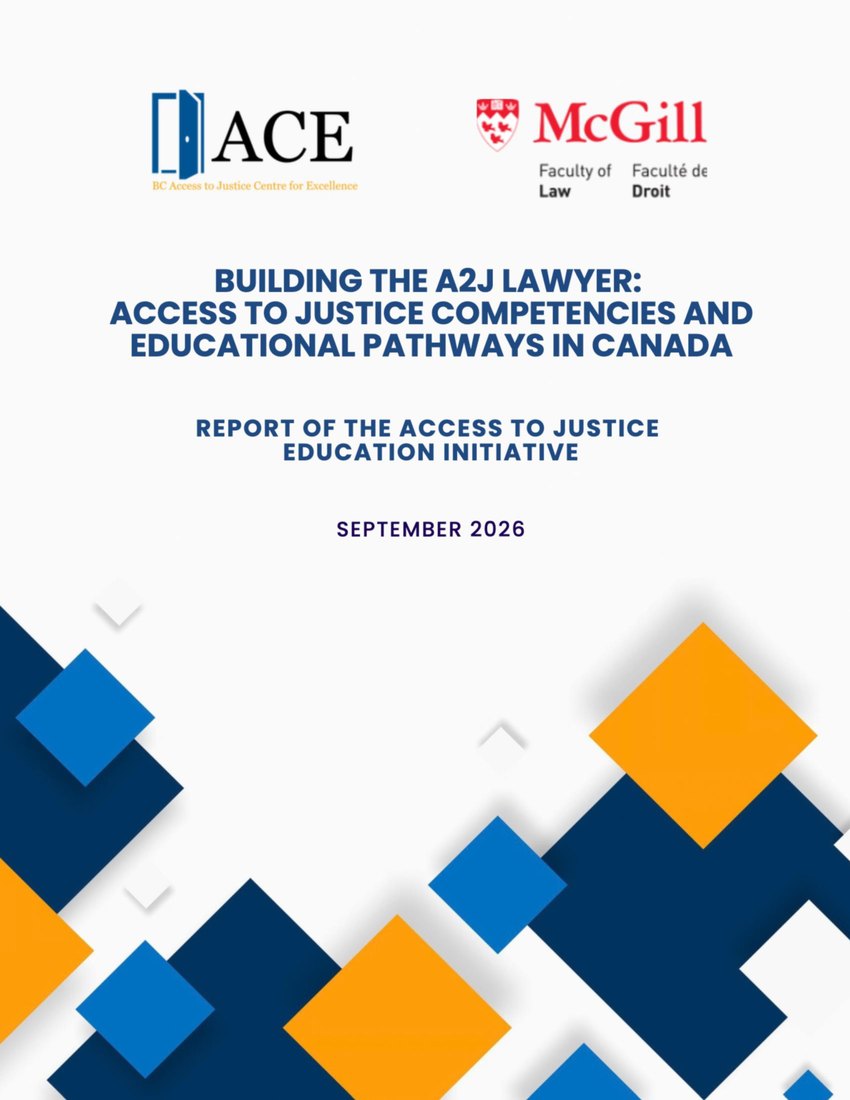
Access-to-Justice Competencies and Educational Pathways in Canada
This report identifies the access-to-justice competencies Canadian lawyers need, from plain-language communication and trauma-informed practice to Indigenous and Reconciliation competencies. It then maps where law students can develop them today.
Between February and July 2026, we reviewed almost 500 courses and 133 clinical and experiential programs across all 24 Canadian law faculties, along with more than 13 law society competency frameworks, and consulted legal educators across the country.
Our report identifies current strengths and potential avenues for enhancing access-to-justice education in Canada.
Valerie L. Le Blanc, Jérémy Boulanger-Bonnelly, Robert Lapper, KC & Michelle Lawrence, Building the A2J Lawyer: Access-to-Justice Competencies and Educational Pathways in Canada (September 2026).
You’ve heard of the access-to-justice crisis, but you’ve never had a chance to learn its causes, its consequences, and what you can do about it? Introduction to Access to Justice is a free, self-paced course built for law students and legal practitioners, and open to anyone who is curious about this topic.
Each module combines short video lectures, curated readings and self-graded quizzes. It is free, online, available in English and French, and you can take it at your own pace.
Modules 5 to 10, on legal aid, regulatory innovation, technology, self-represented litigants, prevention and the future of access to justice, will follow.
The outline of Part 1 of the course, with the full list of readings and resources for each module, is available as a free PDF.
Know of a resource we should add? Please send us your suggestions.
Get a quick look at the themes, structure and materials of each module before you enrol.
Want to bring access to justice into your own courses? Use the outline as a curated list of resources, organized by theme, to find readings that fit your teaching.
Co-lead. Applied access-to-justice research institute at the University of Victoria Faculty of Law. bcace.org

Co-lead. Research lab led by Prof. Jérémy Boulanger-Bonnelly at McGill University’s Faculty of Law. McGill profile

Funder. The Canadian Bar Association’s charitable fund for legal research and education. cba.org